November 2015
Briefing: Rachel Noble and Malou Schueller of the GADN Economic Justice working group on why National Action Plans on Business and Human Rights must integrate and prioritise gender equality and women’s human rights.
Read More
📷 GADN Secretariat and Chair of the Board at GADN Members’ Meeting on Building Effective Anti-racist and Decolonial Practices (September 2022) © Angela Gokani Brasier
GADN produces various publications through our Advisory Group, Working Groups and Secretariat.
You can filter by Issue, browse by resource type or, use the search box.
November 2015
Briefing: Rachel Noble and Malou Schueller of the GADN Economic Justice working group on why National Action Plans on Business and Human Rights must integrate and prioritise gender equality and women’s human rights.
Read MoreOctober 2015
The Sustainable Development Goals (SDGs) are not everything we wanted. However, there are glimpses of concern about gender inequality – or at least a desire to ‘leave no one behind’. And, it does provide us with some valuable rhetoric with which to hold governments to account.
Read MoreAugust 2015
The World Humanitarian Summit (WHS) aims at major global reforms to better protect and assist people affected by crisis. The Gender and Development Network alongside many other organisations have collectively called on the WHS to put women’s leadership, gender equality and gender-based violence (GBV) at the heart of these reforms.
Read MoreJuly 2015
The GADN Women’s Participation and Leadership Working Group has published a paper setting out recommendations on global indicators on women’s participation and leadership. The paper is intended to inform the process for developing a global indicator list for the Sustainable Development Goals.
Read MoreJuly 2015
While some important advances have been made, and must now be protected, the Gender and Development Network (GADN) argues that there are some areas where improvement is still needed. The paper is our response updated in the light of the ‘Final draft of the outcome document for the UN Summit to adopt the Post-2015 Development Agenda’.
Read MoreJuly 2015
The World Humanitarian Summit (WHS) aims at major structural reforms to better protect and assist people affected by crisis. The Gender and Development Network (GADN) believes that transformative change in the humanitarian system is impossible unless reforms account for gender equality and gender-based violence (GBV).
Read MoreJuly 2015
Members of the Gender and Development Network (GADN) Post-2015 working group propose indicators for the suggested targets under Sustainable Development Goal 5 on gender equality and women’s empowerment in the zero draft outcome document of the Open Working Group. These reflect their substantial analysis of the Post 2015 framework which can be found at www.gadnetwork.org.
Read MoreJune 2015
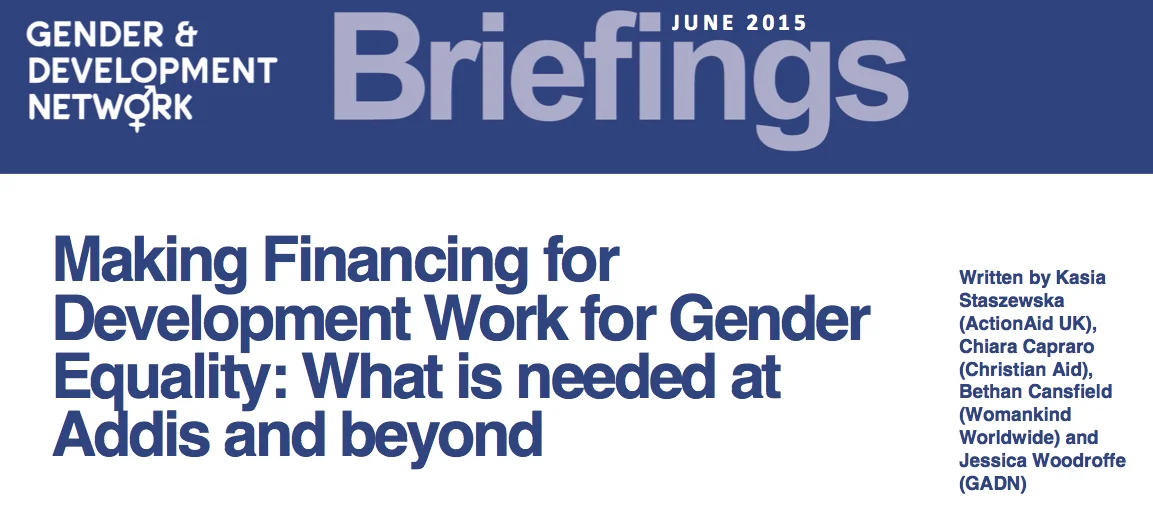
In our briefing paper Making Financing for Development Work for Gender Equality: What is needed at Addis and beyond the Gender and Development Network has outlined how gender equality and women’s rights should be addressed in the Financing for Development Process. In this summary document, we highlight our five key messages in relation to the ongoing negotiation on the Addis Ababa Accord, and make specific language suggestions based on drafts to date.
Read MoreJune 2015
Throughout the Post-2015 process, many governments have successfully championed gender equality within the Sustainable Development Goals (SDGs). It is now vital that sufficient funding is secured and that, crucially, this is of high quality and raised in a way that promotes gender equality and women’s rights. The Third International Conference on Financing for Development (FfD3) provides a timely opportunity. However, although there has been significant visibility of gender equality issues within the FfD3 process, there has been limited recognition that different sources of financing have differing impacts on gender equality or that gender biases within the economy continue to reinforce discrimination against women and girls.
Read MoreGender equality and rights for women and girls - lessons learnt and actions needed. A joint report with Gender Action for Peace and Security (GAPS UK) and the UK Sexual and Reproductive Health and Rights Network.
Read MoreMarch 2015
Explores the concept and practicalities of gender mainstreaming. Sets out the component parts of gender mainstreaming, how these relate to each other, and how they collectively contribute towards the wider goal of gender equality and women’s and girls’ rights.
February 2015
Throughout the discussions around the post-2015 framework some major advances have been made towards the achievement of gender equality, and there are a number of proposals that we believe are essential to protect as we move towards the final deliberations. However, the Gender and Development Network (GADN) remains concerned about various issues that are continuing to undermine the creation of a truly progressive framework strong enough to tackle the deep rooted and persistent gender inequalities that exist.
Read MoreSeptember 2014
In this paper we reflect first on the overall current state of the post-2015 debate and then comment on the final Outcome Document of the Open Working Group (OWG) on Sustainable Development Goals, suggesting what could be usefully kept or improved.
Read MoreSeptember 2014
This briefing discusses how all donors and humanitarian actors participating in the Call to Action can take further steps to translate high level commitments to change on the ground, with the ultimate goal of improving the life, safety, dignity and resilience of women, girls and GBV survivors in current emergencies, including survivors of harmful practices like such as early and forced marriage and female genital mutilation (FGM).
Read MoreJuly 2014
This briefing provides evidence of the many benefits of tackling women’s disproportionate burden of unpaid care work, and suggests practical proposals for implementation and indicators for measuring progress. While we suggest that the current wording of the proposed target could be improved, the recognition of unpaid care in this global development agenda would in itself represent an important advance, and therefore our main concern is to preserve its inclusion.
Read MoreJune 2014
The GADN Violence Against Women and Girls (VAWG) working group have launched the publication 'Harmful Traditional Practices, Your Questions: Our Answers', providing an overview of harmful traditional practices, explaining their causes and consequences and bringing together examples of successful approaches to addressing them.
Read MoreFebruary 2014
The education goal within the post-2015 framework must take this into account; girls and women must no longer be left behind. Further, education and the inclusion of girls and women must not be seen in isolation, being intrinsically linked to other goals, such as the elimination of early marriage, sanitation infrastructure, stopping violence against women and goals and sexual and reproductive health.
Read MoreMarch 2013
The VAWG working group prepared factsheets on key issues ahead of CSW57 in 2013.
Read MoreJanuary 2013
This report argues that to achieve real and sustainable change, the post-2015 framework must tackle the underlying causes of gender inequality and promote women’s empowerment. The most effective way to achieve gender equality is through a ‘twin track’ approach, combining a standalone goal with mainstreaming throughout the framework. Targets across the framework must be transformative so that they reflect a lasting change in the power and choices women have over their own lives and tackle the root causes of inequality.
Read MoreNovember 2012
The Theory of Change draws on the experience of a range of actors delivering programmes and services addressing violence against women and girls, including donor agencies, women human rights defenders, women’s rights organisations and other civil society organisations. Published by ActionAid, DFID and GADN.
Read More